Most operations managers focus on labour, software, or carrier costs when looking for savings. But the answer is often right beneath their feet — in the way the warehouse floor is organised. A poorly designed layout increases travel time, wastes vertical space, and limits throughput no matter how good your team is. When you redesign your warehouse layout with robotics in mind, the financial impact becomes immediate and measurable.
Why Warehouse Layout Is a Strategic Decision, Not Just a Floor Plan
The traditional approach to warehouse design was built around human movement. Wide aisles were necessary for forklifts. Shelving was kept low enough for pickers to reach. Goods were organised by gut feel or historical demand patterns. This made sense decades ago.
Today, it limits you.
A conventional warehouse layout typically uses 40–60% of its cubic space effectively. The rest is consumed by aisle width requirements, unreachable vertical zones, and inefficient slotting. For a 10,000 m² facility, that means thousands of square metres generating zero return.
Poor warehouse layout also affects supply chain efficiency downstream. When pickers travel excessive distances, orders take longer. When storage density is low, you hit capacity limits faster and face costly expansion decisions. When distribution zones are disorganised, pick accuracy suffers. All of these are layout problems — and all of them are solvable.
The Real Cost of Inefficient Aisle Width and Storage Density
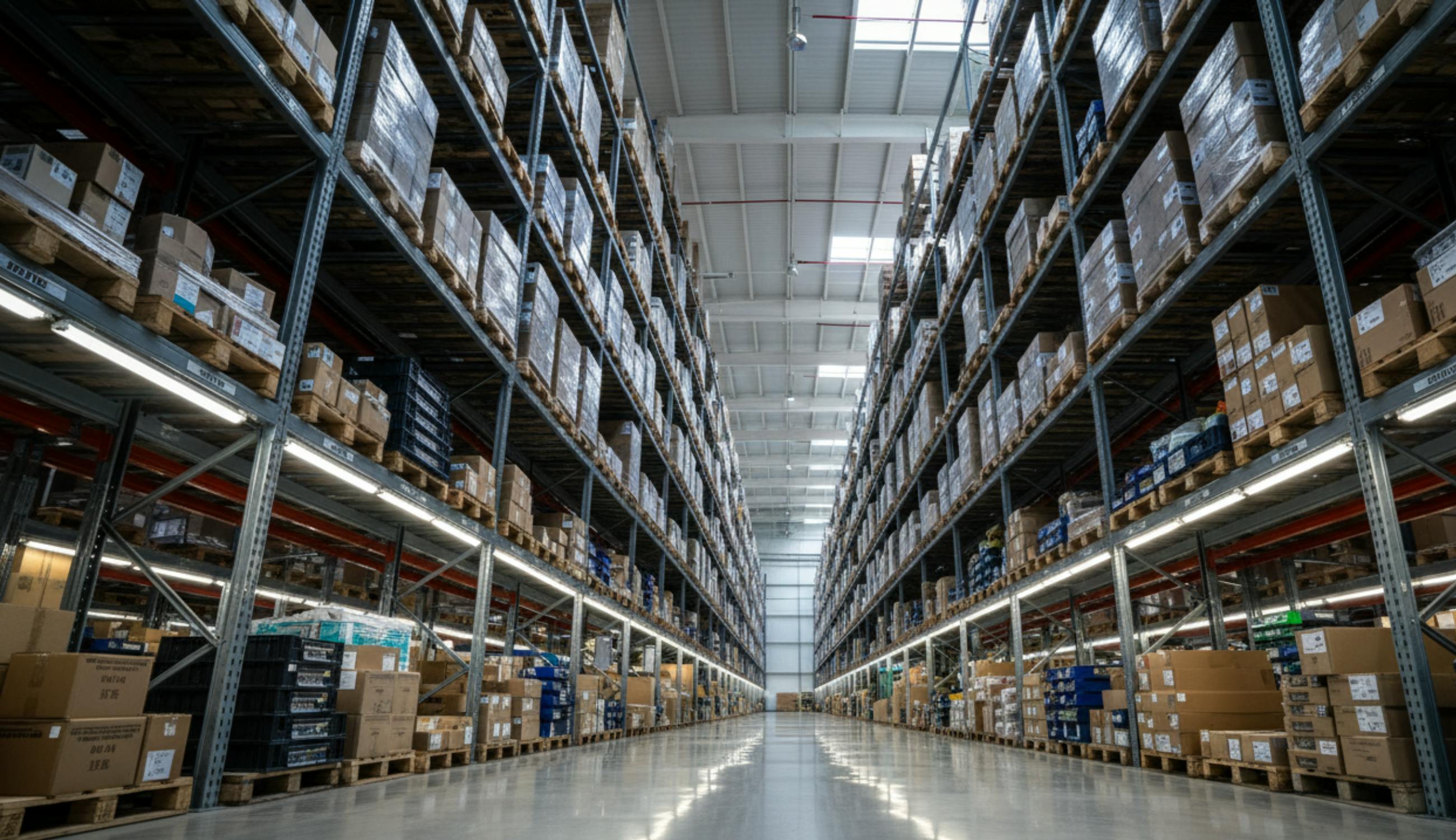
Aisle width is one of the biggest hidden costs in warehouse design. Standard forklift aisles require 3–4 metres of clearance. In a mid-sized facility, this can consume 30–40% of the total floor space. You are, in effect, paying rent on empty space.
Storage density suffers equally. When vertical space above 2–3 metres goes unused — because humans cannot safely work at height without equipment — you are leaving capacity on the table.
The financial consequences are real. Expanding a warehouse costs €500 or more per square metre. If automation can improve space utilisation by 30–50%, the avoided expansion cost alone can justify the investment. That is before accounting for the labour savings, throughput gains, and error reduction that come with a properly designed, technology-enabled layout.
Understanding these fixed cost structures is critical when evaluating whether your current layout is working for or against you — a challenge explored in depth in OPLOG's analysis of logistics fixed cost management and Pay-As-You-Go models.
How Robotics Redefine Warehouse Layout Principles
Autonomous Mobile Robots (AMRs) operate on fundamentally different physical requirements than humans or forklifts. This changes the rules of warehouse layout design from the ground up.
Narrower aisles, more storage. AMRs like OPLOG's TARQAN system can navigate aisles as narrow as 1.5–2 metres — roughly half the width required for forklift operations. That recovered space can be converted into additional rack positions, directly increasing storage density without expanding the building footprint.
Vertical space becomes usable. Goods-to-person robotics eliminate the need for pickers to physically access every shelf location. When robots handle retrieval, storage systems can extend to 4–8 metres in height, dramatically increasing the effective cubic capacity of the same facility.
Slotting becomes dynamic. Traditional warehouse slotting optimises item placement based on velocity — fast movers near the front, slow movers deeper in the racking. With robots, slotting can be optimised for density and replenishment efficiency instead. This unlocks further storage gains.
Zones become flexible. Human-operated warehouses require fixed, clearly delineated zones for safety. Robotic systems with intelligent fleet management can dynamically reassign zones based on real-time demand, removing the inefficiency of static layout configurations.
OPLOG's TARQAN: High-Density Technology in Practice
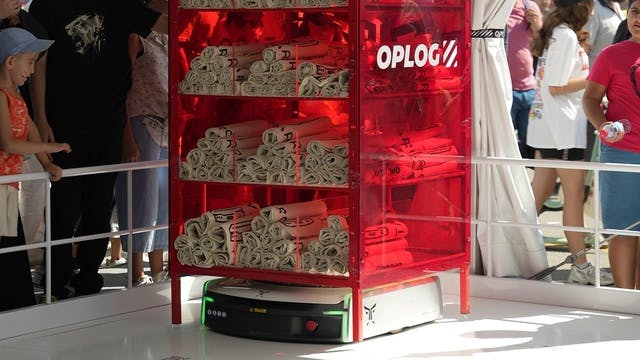
OPLOG's proprietary AMR system, TARQAN, was designed specifically for the demands of modern fulfilment operations. Unlike third-party robotics solutions that require heavy integration work and ongoing vendor dependency, TARQAN was built in-house and refined through years of live production use.
In terms of warehouse layout impact, TARQAN delivers on several fronts.
It enables narrow-aisle operation, freeing up floor space that can be converted into additional storage positions. It operates at height that would be inaccessible or unsafe for human pickers, activating vertical capacity that conventional layouts leave untouched. And it works within OPLOG's goods-to-person model, where inventory comes to the picker rather than the picker walking to the inventory — eliminating the single largest time cost in manual warehouse operations.
OPLOG's space utilisation data indicates improvements of 30–50% when TARQAN is deployed in place of conventional pick-and-pack configurations. In practical terms, a 10,000 m² facility operated with TARQAN can achieve the effective throughput and storage capacity of a 13,000–15,000 m² conventional facility. The cost of not building that extra space is the immediate return on the technology investment.
For businesses evaluating whether a fulfilment partner can genuinely support their growth, understanding the technology behind the operation matters. OPLOG's approach to smart fulfilment — and where it is headed in 2026 — is covered in detail in this overview of smart fulfilment trends.
Warehouse Distribution Efficiency Starts with the Right Zones
Warehouse layout optimisation is not only about storage density. It is also about how the facility handles the flow of goods from inbound receiving through to outbound dispatch.
An efficient warehouse distribution layout separates inbound and outbound traffic flows. It places high-velocity SKUs closest to dispatch areas. It minimises cross-traffic between picking, packing, and staging zones. And it builds flexibility into the design so that seasonal volume surges do not require physical reconfiguration.
Robotics support all of these principles — but they require a different zoning strategy than human-operated warehouses. AMR-based operations typically use dedicated pick stations where robots deliver goods, rather than scattered pick faces spread across the floor. This concentrates fulfilment activity, reduces the footprint of the active pick zone, and makes quality control easier.
The design of fulfilment centres — what they do, how they are structured, and how technology changes their economics — is a topic worth understanding if you are evaluating your storage solutions. OPLOG has published a complete guide to fulfilment centres that covers these principles in accessible detail.
Warehouse Risk Assessment: Layout Decisions Have Operational Consequences
Changing your warehouse layout — or transitioning from a conventional model to a robotics-enabled one — carries operational risk. The transition period, the integration requirements, and the impact on existing inventory management processes all need to be planned carefully.
A structured warehouse risk assessment before any major layout change is essential. It identifies single points of failure in your current operation, flags dependencies that could disrupt fulfilment during transition, and provides a baseline against which post-implementation performance can be measured.
OPLOG's own framework for warehouse risk assessment walks through the key considerations — from infrastructure readiness to workforce impact — that logistics teams need to address before committing to layout changes.
Supply Chain Efficiency Beyond the Four Walls
Warehouse layout optimisation delivers direct cost savings. But its impact extends beyond the building itself.
When orders are picked faster and more accurately, last-mile delivery performance improves. Carriers receive accurate, well-prepared shipments on time. Customer satisfaction increases. Return rates fall. The financial benefit of a well-designed warehouse layout compounds through the supply chain.
This connection between internal warehouse performance and external delivery outcomes is why logistics operations cannot be evaluated in isolation.
OPLOG's analysis of last-mile speed examines how fulfilment centre efficiency translates directly into competitive delivery performance — a growing priority for e-commerce brands competing on customer experience.
Choosing the Right Fulfilment Partner for Layout-Driven Efficiency
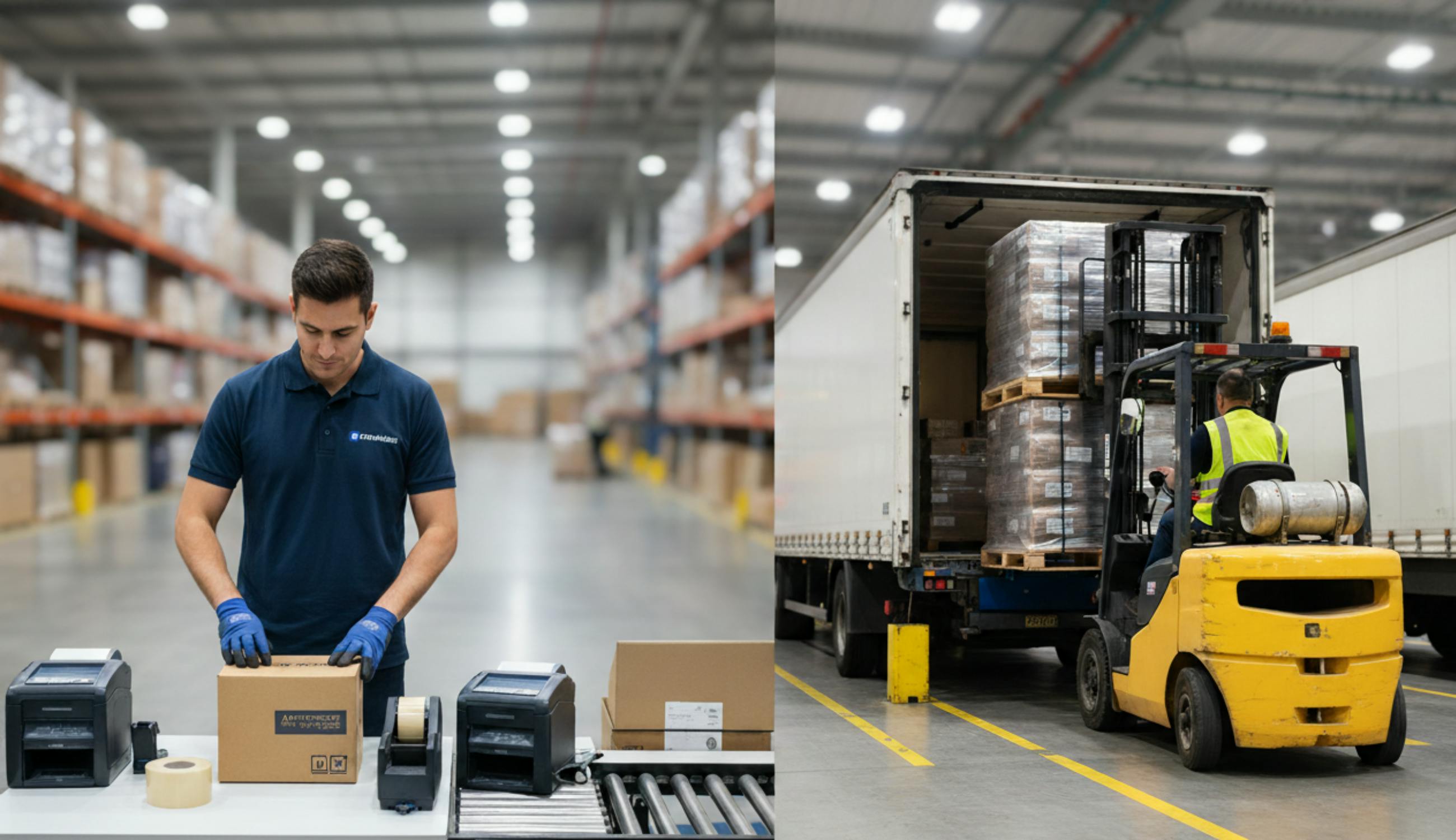
For brands that do not operate their own warehouses, the layout and technology decisions belong to their 3PL partner. This makes partner selection a critical strategic choice — one that directly affects your storage costs, throughput capacity, and supply chain efficiency.
Not all 3PL providers invest in warehouse layout optimisation or robotics. Many continue to operate conventional manual warehouses and pass the cost of those inefficiencies on to their clients through higher per-unit fees. Selecting a partner whose infrastructure is built for density and automation translates directly into lower fulfilment costs and better scalability.
For UK brands specifically, evaluating 3PL technology infrastructure is a key part of due diligence. OPLOG's guide on choosing the right 3PL provider for UK brands covers the evaluation criteria that matter most — including warehouse technology, pricing models, and scalability.
Conclusion
Warehouse layout is not a one-time design decision. It is a continuous strategic lever. As your volume grows, your SKU range evolves, and your fulfilment speed requirements increase, your layout must evolve with them. The question is whether your current setup — and your current partner — can support that evolution, or whether it is actively limiting it.
OPLOG's TARQAN robotics enable a fundamentally different approach to warehouse layout: narrower aisles, activated vertical space, dynamic slotting, and goods-to-person pick stations that concentrate fulfilment efficiency. The result is measurably better storage density, lower cost per order, and a facility footprint that scales without proportional expansion in square metres.
If your warehouse layout is costing you more than it should, it is worth having a conversation about what a technology-driven alternative could deliver. Get a quote from OPLOG and see what optimised fulfilment looks like for your operation.
FAQ